
hello new readers and happy belated mid-autumn! 🥮🐇🌕🍂 today i bring to you all a topic ive been drafting since i started this newsletter back in march...1
1. xuanzong
元稹《行宫》
yuán zhěn《 xíng gōng 》
寥落古行宫,宫花寂寞红。
liáo luò gǔ xíng gōng, gōng huā jì mò hóng。
白头宫女在, 闲坐说玄宗。
bái tóu gōng nǚ zài, xián zuò shuō xuán zōng。

yuan zhen (779-831) travelling palace
in the desolate ancient travelling palace, palace flowers forlornly bloom
white-haired palace maids sit idly, speaking of xuanzong
notes:
traveling palace: a palace for the emperor when he travels… here, yuan zhen refers to shangyang palace, luoyang.2
xuanzong: emperor xuanzong of tang (685-762, r. 712-756).
i think here we cannot avoid a long-ish historical preamble (i don’t recommend skipping this).3
according to the textbook narrative, the tang dynasty, one of the great empires of the world, was at its most prosperous during xuanzong’s reign. in the initial years, a vigorous ruler, he:
reformed the bureaucracy, increased tax revenues through reregistering the population, improved the transportation system, and established a permanent military force along China’s northern frontiers.
the empire under him was not only expansive and prosperous, but also culturally efflorescent:
[The period during Xuanzong’s reign] is rightfully ranked as the classical period of Chinese art and literature, as it set the high standard to which later poets, painters, and sculptors aspired. The expressions and images contained in the poems of Li Bo and Du Fu... The vigorous brushwork of the court painter Wu Daozi and the naturalist idiom of the poet and painter Wang Wei became artistic paradigms for later generations.4
we know that the center of tang civilization and culture was its capital in chang’an, but there was also a secondary capital, the so-called “eastern capital” in luoyang. the “ancient traveling palace” in the poem refers to shangyang palace in luoyang, where the emperor lived, held court, and banqueted his officials, when he divided his time from chang’an. as such, the mention of “ancient traveling palace” in the poem is a reference (synecdoche?) for the vigor and prosperity of xuanzong’s reign.
however, in his later years, xuanzong began to neglect state affairs, retreating further into the arts, daoism, and favor for the infamous consort yang (yang guifei). the impression we often get is of xuanzong losing himself in courtesans, dancers, all manners of entertainers, in revelry and leisure trips, while control over his empire slipped from his grasp.
this culminated in the rebellion instigated by the (ethnically other) general an lushan (755-763), which just about wrecked the entire empire and came so close to the center of power that xuanzong was forced to abandon his throne and flee for his life. although the rebellion was eventually quelled, the dynasty never fully recovered from it.5
yuan zhen's poem addresses precisely this, with his painful awareness that he lives during a lesser time. the eastern capital, luoyang, was devastated during the rebellion and the shangyang palace grounds were torched,6 and probably never rebuilt. several decades later, when our poet yuan zhen was writing, it is clear that the palace had long fallen into desolation.
the flowers still bloom, but do so in a "lonely” or “forlorn" manner, as no longer do they do so for the audience of the emperor. while we might imagine the palace bustling with youthful, beautiful girls during xuanzong’s time, now, they have all become old women. all that is left of xuanzong’s grand palace are ruins.7
this general format of evoking the past through images of ruins in the present is fairly common across all eras of chinese poetry — we have just seen it in “there the millet is lush.” but xuanzong’s time in particular is one of those subjects that corners this market in nostalgia, giving rise to a wiiiiddddde corpus of work.
The aggregation of other sources leave little question that the images of a drunken Li Bai and of Xuanzong enjoying musical performances and other pleasures in the company of Consort Yang were familiar fare in the mid-ninth century—as indeed they still are today, and that a meeting with a survivor from Xuanzong's day was a favored device to create a platform for reflecting upon that age.8
in the above quote, the “survivor from xuanzong’s day” refers specifically to a xu yunchang, a member of the musical troupe xuanzong and yang guifei had kept during the glory days. a less obscure reference would be du fu’s poem “encountering li guinian in jiangnan.”9 in today’s issue, we have the image of a palace that was surely once splendid and luxurious -- a whole variety of contexts could bring about reflection of xuanzong’s time, and all these representations are ultimately “[symbols] of imperial pleasures once enjoyed and then irrevocably lost.”10
what makes this poem interesting to me is that the “white-haired palace maids” is a part of the ruin rather than a participant in the historical contemplation of it.
yuan zhen does not make any value judgements, but this leaves unlimited implications for this work: is there an implicit criticism of xuanzong’s failure in governance? does it empathize with his fall?11 (again, in owen’s words, as he is a “human trapped in the determined mechanism of nature's cycles, sheng-shuai, a splendor and a fading”)
as always, it is hard to pick between these truths, and it must be uneasy sitting with them. yuan zhen says about as much, as we can imagine he feels as the palace appears, “desolate” and “forlorn.” conversely, maybe its because they are described as just “idly sitting,” the palace maids reminisce like it is part of casual conversation.
the palace maids effect this unease on the poet12, but they themselves are free from it, not at all “choked” in the “heart within,” to borrow last issue’s phrase.13
do these women know they are a symptom of dynastic decline? does yuan zhen consider himself a symptom of the same? or does he, as an observer, rise above it?
its also entirely possible i read the poet too uncharitably, in which case i present:
2. chen houzhu
the author of the following poem was a younger contemporary of the previous, and as such dealt with similar themes of decline. rather than ruminating on tang ruins, he alludes to an earlier dynasty.
杜牧《泊秦淮》
dù mù 《 bó qín huái 》
烟笼寒水月笼沙,夜泊秦淮近酒家。
yān lóng hán shuǐ yuè lóng shā,
yè bó qín huái jìn jiǔ jiā.
商女不知亡国恨,隔江犹唱后庭花。
shāng nǚ bù zhī wáng guó hèn,
gé jiāng yóu chàng hòu tíng huā.

du mu (803-852) boating through the qinhuai river
mist shrouds cold water and moonlight shrouds sand, boating at night along the qinhuai, drawing near taverns.
the song-girl who knows nothing of a fallen state's anguish, across the river, still sings of inner court flowers.
qinhuai: tributary of the yangtze river, flowing through present day nanjing, jiangsu province. this places the poem in the nanjing/jiangsu region.
inner court: the part of the palace in which imperial women and their handmaids live. roughly corresponding to the “harem”
inner court flowers: a reference to a poem “jade trees and inner court flowers” 玉树后庭花, composed by chen shubao 陈叔宝, the last ruler of the chen dynasty (557–589).14
as we can see, the chen dynasty was extremely short lived, and as its last ruler, chen shubao has not escaped judgements of culpability. he comes down in history as a character rather similar to li yu, the pleasure-seeking ruler who cost himself his kingdom (and perhaps even nastier).
the fact that his legacy, the “jade trees and inner court flowers" is a work that’s all about the beautiful women in his palace did not help his latter-day reputation. his poem has became a symbol for kingdom-felling debauchery, the “sound of a fallen state” 亡国之音.
i mentioned earlier that the tang dynasty never recovered from the shock of the an lushan rebellion. here, it is also important to note that this fact was acutely perceptible by those living in the later tang (such as our poets today), and the source of much anguish.15 therefore, ruefully aware that he lives in a period of tang decline, and reminded of the ill-fated chen dynasty, du mu laments: how ironic it is to hear this song at this time.
the subtext is probably kind of like, look at how degenerate my generation is, they know how to indulge themselves, as if the declining state of our empire does not concern them. do they know “nothing of a fallen state's anguish”? have they not learnt the lessons history has made of those pleasure-seekers that came before?
but that is not what the poet says. his rhetoric involves not the degeneracy of his times, but singling out a “song-girl” (商女 shāng nǚ), who can stand to make merry because she is ignorant of the historical implications of her performance. even though i understand rhetoric is just rhetoric, he’s not really trying to scapegoat her, i still have to point out that he completely disregards the fact that the song-girl sings not for merry but because she is a song-girl.
whether consciously or not, in both yuan zhen and du mu’s poems, the subjects of the poets’ observation show up as lesser subjectivities. they live and see the same world the poets do but always seem blind to the greater conclusions the latter draw from observation (or that which readers draw from the work).
when filtered through the poet's re-presentation, the action and voices of these characters lose agency and they seem to become mere placeholders, dumbly reflecting back on the extra-lucid, learned, moral, poet.
while recognizing the importance of rhetorical techniques in the craft of poetry, how do we reckon with the class and gender dynamic created between the poet and the observed? do i reckon i have misrepresented the poets in my manipulation of their ideas towards making my argument?
it is worth considering: what do we do when we represent subjectivities other than our own in our works? is it ever possible to do so fairly?
a while ago my friend a told me she wanted to write a short story about ethnography, representation, and what we owe to the people we write about, and it inspired me to work on this again, even though i also tabled it again after.
now that i finally finished i dont think she even still has that story idea anymore… hope you still enjoy this, haha…
a long time ago i wrote about a few landscape poems in which the poets’ experience of the landscape is mediated by their imagination of the experiences of the animals inhabiting them. in those poems, thus, the poets intimate the inner lives of wild animals (a kind of anthropomorphism?).
as a follow up i had wanted to write about a few more where poets guess at the inner lives of human subjects, specifically, those people that were not a part of the writers’ learned circles.
https://baike.baidu.com/item/行宫/5867288
im taking a lot of this from the britannica entry on xuanzong: https://www.britannica.com/biography/Xuanzong
https://www.metmuseum.org/toah/hd/tang/hd_tang.htm
this sounds dramatic but from a purely physics point of view, unsurprising: if xuanzong's reign was the peak, then what followed would by definition be decline.
note that the sights of past’s splendor are never actually stated, we are merely led to imagine them by reflecting on their ruins.
“8 Figments of Memory: ‘Xu Yunfeng’ and the Invention of a Historical Moment” in Memory in Medieval China: Text, Ritual, and Community
though of course, if you were to read the britannica page on xuanzong, you would find that his reign had its Problems
〔唐〕杜甫《江南逢李龟年》
岐王宅里寻常见,崔九堂前几度闻。
正是江南好风景,落花时节又逢君。
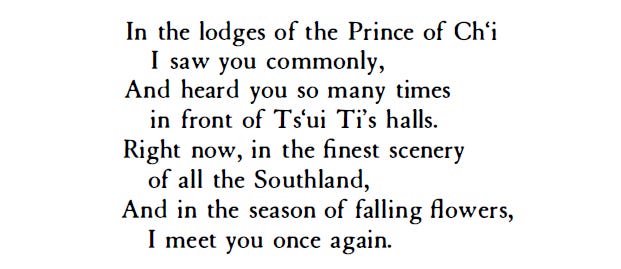
that quote refers to when premodern writers reminisce about xuanzong, but to a great extent we do the same thing now, we still talk about its splendor and mourn its loss, as if that loss was something that is still palpable, or something we had personally experienced.
all common themes in premodern writings about xuanzong.
明皇已往,遗宫寥落,却借白头宫女写出无限感慨。
this impresses stronger when i think about du fu’s poem again, in which (still based on speculation) i have the feeling that li guinian, the persona who appears that isn’t the author himself, is a participant.
fun fact, chen shubao’s father, chen baxian, the founder of the chen dynasty, is one of the protagonists of my capstone!! as such, i think of them both almost like friends. my good bro baxian and his boy shubao 😎
often, traditional interpretations say that in comparison to the high-spirited poetry of the high tang (during and before xuanzong’s reign), poems in the later years of the tang did not match the same kind of exuberant energy.