高珩《春日杂咏》
gāo héng 《 chūn rì zá yǒng 》
青山如黛远村东,
qīng shān rú dài yuǎn cūn dōng,
嫩绿长溪柳絮风。
nèn lǜ cháng xī liǔ xù fēng 。
鸟雀不知郊野好 ,
niǎo què bù zhī jiāo yě hǎo,
穿花翻恋小庭中。
chuān huā fān liàn xiǎo tíng zhōng 。
Gao Heng "Miscellaneous poem on a spring day”
Green mountains, black as eyebrows, are at the far eastern side of the village (1),
Through young greens and a long creek, the wind carries willow catkins. (2)
Birds and sparrows do not know the beauty of open lands,
They flit and fly longingly through flowers in the small courtyard.
(1) 黛 dài means black, and also the pigment that was used by women for coloring in eyebrows.
(2) lesson in botany im not qualified to give: the fruit of the willow tree are these almond shaped blobs that feel kind of like cotton, as such, they become easily airborne in wind. as a plant strongly associated with spring, mentions of willow are a signal that a poet is trying to conjure up an atmosphere of spring (although in this case it has been spelled out for us in the title).* on structure: this poem is written in 2 couplets, meaning two sentences of two parts each. each part is 5 words long (alternatively, 7). i have broken each couplet into separate lines for formatting purposes, but imagine them like this:
xxxxx,xxxxx。
xxxxx,xxxxx。
Usually within a couplet there is some parallelism between the elements in the same position: e.g., 青山/嫩绿 (green mountains/ tender greens) are both landscape features, 郊野/小庭 (open lands/ small courtyard) are both types of spaces. The elements are supposed to belong in the same category, but present as contrasts or complements to each other.

In this poem I first imagine a viewfinder. It starts panoramically, pointed at a distance. At its extreme, are a stretch of green mountains, so far away that to the limited human eye, appears black. In the foreground of this image we might see modest villager houses, along with their courtyards and fields, dotting the expanse.
Black is an interesting choice of word, definitely not my first (common-sensical?) expectation when i look at things far away irl — why not gray? Furthermore, rendered in English, there is this connotation of dreariness and death, and I don’t think this is the intended effect in Chinese. Insofar as black can have shades, the deep, highly pigmented 黛 dài gives an immediate sense of saturation in color, probably from a density in vegetation in the mountains, and thus somewhat counterintuitively suggests a lushness.
The camera is then brought in to the poet’s immediate surroundings, a garden or courtyard, possibly his own. This movement is facilitated by the intervening description in the second half of the first couplet: one imagines their gaze carried by the length of the creek, or ferried by the movement of the wind, advancing from the far to the near.
Here, the grander landscape element of the mountain is replaced by the minor, garden flowers and small birds. He personifies the garden birds, assigning them the capacity emotion: They love and long for the flowers, but only do this since they do not know of a world outside, of open, more splendid sights.
I am tempted to read the birds as a projection of the author’s own anxieties, given their investment with consciousness, although this method could be reductive at times. Implicitly, if the birds circle within the courtyard, then so does the poet who observes them. Although the poet has a degree of intuitive knowledge of greater heights/ grander soaring/ loftier freedom elsewhere, it is similarly unfulfilled. Might we interpret some entrapment or unrealized ambition into the author’s own life?
In this poem I think there is a strong underlying sense of pity (怜), but is it directed at the animals, for loving something that is “lesser”, or the poet himself (and ourselves?), in his knowing entrapment? Of course, the scene is still perfectly picturesque, and any observation of this has been made possible in the first place by the poet’s confinement within it. Hence, I read both a contentedness to remain within limitations and a longing for what’s beyond them, but given no further information beyond these two lines, am unsure which way the scale tips.
I also hoarded another poem a while ago that is quite similar:
晁冲之《春日》
cháo chōngzhī 《 chūn rì 》
阴阴溪曲绿交加,
yīn yīn xī qū lǜ jiāo jiā ,
小雨翻萍上浅沙。
xiǎo yǔ fān píng shàng qiǎn shā 。
鹅鸭不知春去尽,
é yā bù zhī chūn qù jìn ,
争随流水趁桃花。
zhēng suí liú shuǐ chèn táo huā 。
Spring Day
Under the shade of crisscrossing greens a creek meanders,
Light rain topples duckweed, scattered atop like fine sand.
Swans and geese do not know that spring has been expended,
They race one another in flowing water, pursuing peach blossoms (1).
(1) The imagery of peach blossoms are employed in a very similar way as with willow catkins in the previous poem. They shout Spring-ness at you.
If what the poet means here is confusing, it’s because hes employing very particular trope — 伤春, the lamenting of the end of spring. It’s a melancholic moment, produced by the fact that the things associationed with spring are too desirable. If spring signifies flourishing, rejuvenation, and warmth, then its end calls to mind the dissolution of same. It is necessarily coupled with loss. Here, the poet brings up the passage of spring to mean that This is the season of melancholy and grief, although these stay implicit in the text.
Again, the poet claims to be privy to knowledge his personified subjects are not: blissfully ignorant, the water birds make merry in the water. Do we perhaps read a degree of envy for their naivety? Or contentment in the present moment?
Finally, I would like to raise a point I am still thinking through. In both these poems, the animals are described to be lacking of some sort of knowledge, but it seems to me that this precisely suggests a capacity for it. I can’t decide if they are unknowing because they are merely dumb animals, or because they just don’t know yet. Of course, the poets could also be referring to a kind of Animal Knowledge different from knowledge as it is experienced by humans. Regardless, their descriptions confer their animal subjects a measure of agency that enlivens these works as a whole.
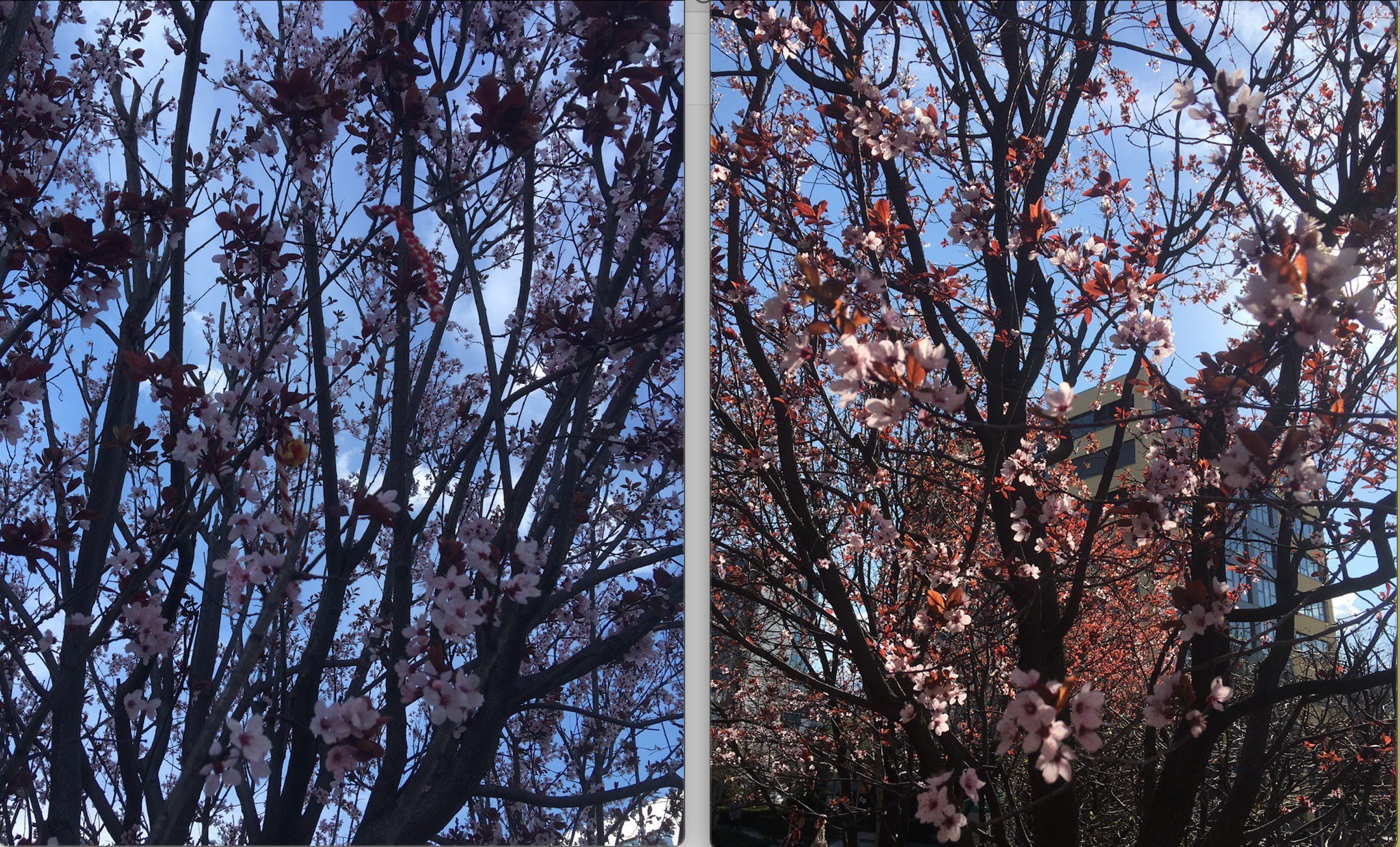
Thoughts? Two more poems like these next time! Finally, two photos of peach blossoms (probably) sent to me by a friend from her hometown: